Press
the book
The Architecture of Money
A Framework for Understanding Monetary Stability and Collapse
Latitude Zero Press · December 2026
Paperback (6 × 9 in) and ebook; hardcover to follow.
- paperback:
- ISBN 979-8-9826119-0-1
- hardcover:
- ISBN 979-8-9826119-2-5
- clothbound:
- ISBN 979-8-9826119-3-2
- ebook:
- ISBN 979-8-9826119-1-8
description, about 100 words
How do societies keep money honest? The Architecture of Money reads every monetary system through the constraints that limit its expansion—physical, institutional, and network or algorithmic—the cost of cheating them, and whether people can read those limits well enough to trust them. From Rome's denarius to Bretton Woods, Zimbabwe, Athens in 2015, and Bitcoin, it traces a recurring arc of erosion, stress, rupture, and reanchoring. The framework is diagnostic, not predictive: it names the conditions under which constraints have held, and the signs that often come before a rupture.
description, about 300 words
Money is a human invention—a social technology that enables strangers to align their work, share resources, and commit to future obligations without ever meeting. In stable times it disappears into the background. When it fails, it becomes visible in ways no one can ignore.
The Architecture of Money begins with a simple question: how do societies keep money honest? Its answer is a framework. Every monetary system limits its own expansion through physical constraints, such as gold reserves or energy throughput; institutional constraints, the rules and enforcement rooted in governance; or network and algorithmic constraints, sustained because enough participants agree to make defection costly. Those limits set the cost of cheating—of creating claims that exceed real capacity. Above them sits cultural legibility: whether people can read a system well enough to trust it.
The book's central claim is about how long regimes last, not about how they end. The soundness of a regime's constraints decides whether the mismatch between claims and capacity grows; legibility decides when that mismatch is noticed and how much of it the public will tolerate.
From Rome's debasement and the Florentine florin to Bretton Woods, the hyperinflation of Zimbabwe, the bank queues of Athens in 2015, and today's digital experiments, the book follows a recurring arc of erosion, stress, rupture, and reanchoring, and it defends an unfashionable claim: some drift, bounded and legible, can be productive. Its appendices set out the core models, the diagnostic dimensions, the cases where the framework fails, and the strongest objections to it.
The framework is diagnostic, not predictive. It names the signs that often come before a rupture and reads where a system is exposed, not when it will break; it does not prescribe what money should be.
from the back cover
Money holds for as long as its limits can be read.
Athens, June 2015: a line of ATMs, a €60 limit, a screen that goes black. Harare, 2008: a café weighing banknotes by the brick. Florence, 1345: the gold florin still pure while the banks behind it fail. Money didn't "break" so much as cease to coordinate.
This is not a book about what money should be—it's about understanding what money is and why it breaks. The Architecture of Money reads money the way an engineer reads a structure: by asking what carries the load, and how it fails. Every monetary system limits itself—through physical scarcity, institutional rules, or network consensus—and those limits set the cost of cheating. When that cost falls, claims drift past capacity unseen; when the story stops making sense, trust can go all at once.
From the Roman denarius to Bitcoin, from Bretton Woods to central bank digital currencies, the durability of every regime depends on whether its architecture of constraints is legible enough to be trusted before it is sound enough to be analyzed. This book shows you how to tell which is which—before the screen goes dark.
about the author
Felipe Meneses Falconi (b. 1995) is an engineer and independent researcher based in Quito, Ecuador. He has researched and invested in global markets for a decade, and in monetary systems and digital assets since 2017.
His interest in money began at sixteen, when he read Modern Money Mechanics, a Federal Reserve booklet explaining how banks create money when they lend. The idea that money is made in ledgers set him on the path that led to this book.
He studied automotive engineering at Coventry University, holds a first-class degree in motorsport engineering from De Montfort University, and completed the Cambridge Digital Assets for Enterprises course at Cambridge Judge Business School in 2026.
The cars he has restored by hand taught him slower lessons than any degree, patience first among them. A machine yields its reasons slowly, and only to those who stay. He writes from a country that gave up its own currency in 2000, and he approaches money the way an engineer approaches any structure: by asking what carries the load, and how it fails.
He maintains thearchitectureofmoney.com, where the framework's readings are dated, scored, and published with open data.
The Architecture of Money is his first book.
cover
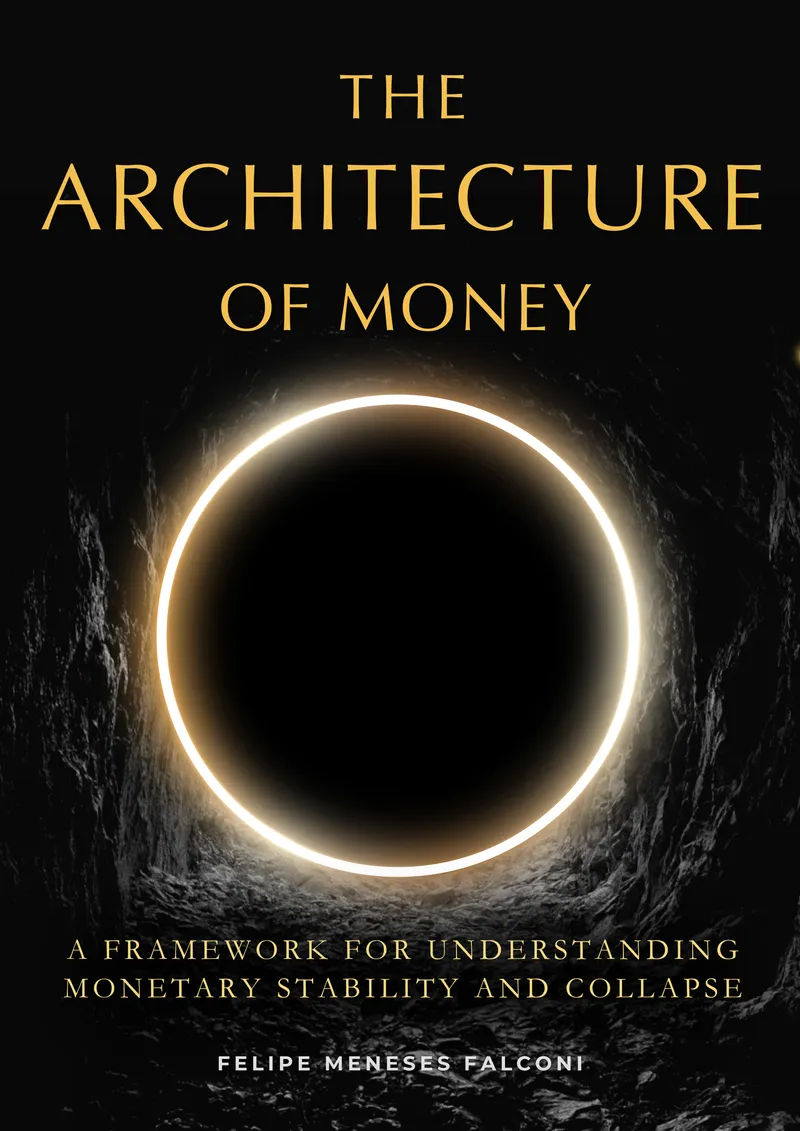
download · PNG, 4419 × 6250 px
Cover art by the author. Cover design by HMD Publishing.
author photo · download · PNG, 1024 × 1024 px

contact
For review copies, interviews and permissions, write to felipe@thearchitectureofmoney.com.